
Baccarat by the Numbers: 10 Betting Methods × 10 Bankroll Patterns, Simulated 100,000 Times Each

This image is an illustration, not a photo of an actual facility.
We calculated baccarat probabilities and house edge, and simulated 10 betting methods such as the Martingale × 10 bankroll patterns, 100,000 times each. We checked in numbers the share of sessions that reach the target or lose the bankroll, the average loss, how results change with the number of hands, and whether the scoreboard can predict the next hand.
Baccarat is a game where you simply predict whether the Player or the Banker will win. That is exactly why many people wonder "how should I bet?" and "are there streaks?" In this article, the CASINO PASSPORT editorial team calculated the probabilities of baccarat and summarized the results of running 10 betting methods and 10 bankroll-and-target patterns on a computer, 100,000 times each. The rules themselves are explained in Baccarat rules and how to play.
To be clear from the start: this article is not a way to win. It uses numbers to confirm how the game works: whatever betting method you use, the longer you play, the more you lose on average, at about 1% of the amount you bet. Decide before your trip how much you will spend at the casino, and enjoy yourself within that limit.
The short answer
- The probabilities per game are about 45.9% for Banker, about 44.6% for Player and about 9.5% for a Tie. The casino's share (house edge) is about 1.06% for Banker, about 1.24% for Player and about 14.4% for Tie
- Betting systems such as the Martingale raise the "share of sessions that reach the target," but they also raise the "share of sessions that lose the whole bankroll." In all 100 combinations, the average loss relative to the total amount bet stayed at around 1%, and the betting method did not change it
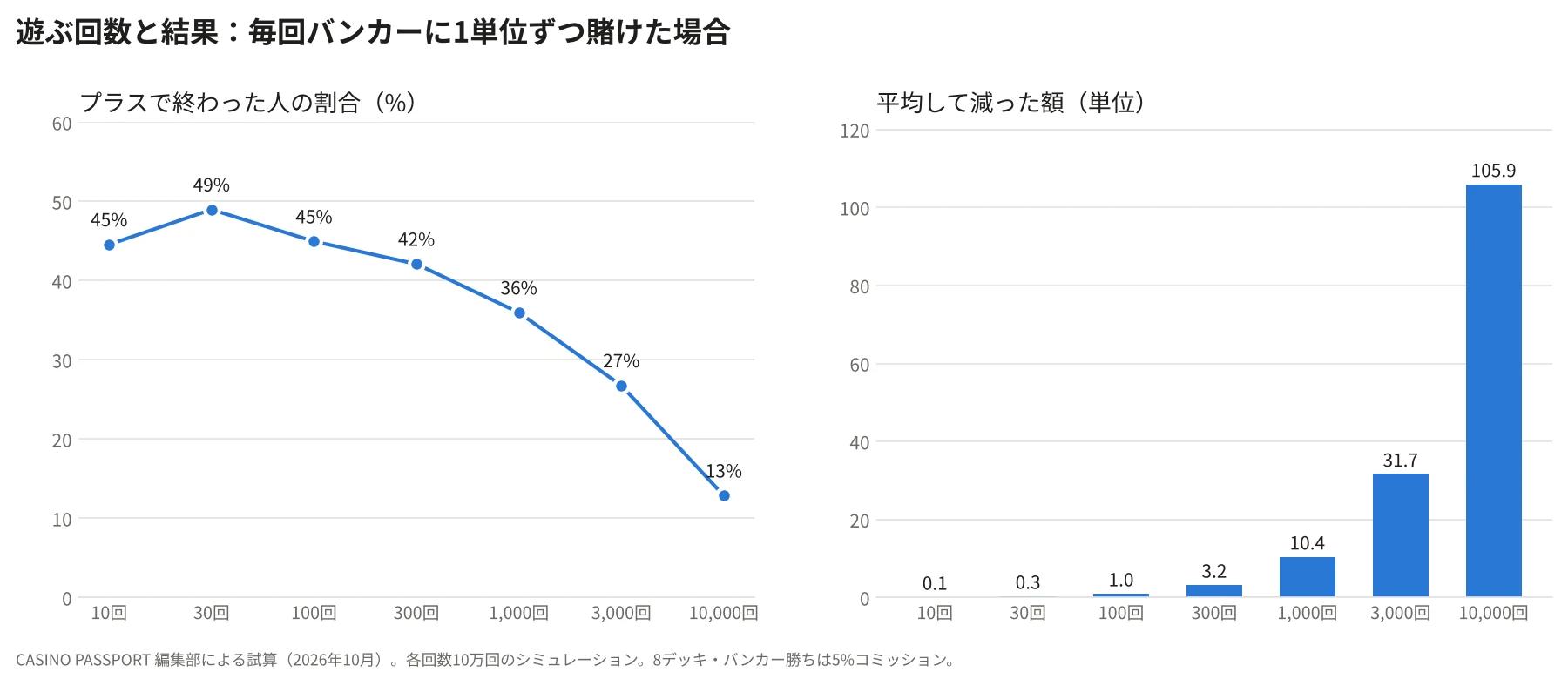
- When betting the same amount every time, the share of people who ended up ahead was about 49% after 30 hands, about 42% after 300 hands and about 27% after 3,000 hands. The more you play, the more the average loss decides the result
- No matter how many times Banker had won in a row, the share of next hands won by Banker stayed almost the same (checked over about 16.28 million games). The scoreboard (the display of past results) cannot predict the next result
Probabilities per game and house edge
Based on the rules in Paradise Casino's official game guide (how cards are dealt; a Banker win pays 95% after a 5% commission; a Tie pays 8 to 1), we calculated the probabilities for cards dealt from an 8-deck shoe (8 decks of playing cards, 416 cards) by counting every combination.
| Bet | Probability of winning | House edge |
|---|---|---|
| Banker | 45.86% | approx. 1.06% |
| Player | 44.62% | approx. 1.24% |
| Tie | 9.52% | approx. 14.4% |
Calculating from these probabilities and payouts how much you lose on average relative to the amount you bet (the house edge) gives about 1.06% for Banker, about 1.24% for Player and about 14.4% for Tie. Banker wins more often, and the 5% commission evens out that difference. The Tie pays 8 to 1, but it comes up only about 9.5% of the time, so the casino's share is large.
We could not confirm on the casinos' official websites how many decks are used. Even when calculated with 6 decks, the house edge is about 1.06% for Banker, about 1.24% for Player and about 14.4% for Tie, almost unchanged.
Assumptions of the simulation
- Amounts are expressed in "units." 1 unit = the table's minimum bet. For example, the official website of Seven Luck Casino Seoul Dragon City lists Mini Baccarat bets as KRW 50,000 to KRW 30,000,000, so in this case 1 unit = KRW 50,000 (confirmed in October 2026)
- We set the maximum bet per hand at 600 units (KRW 30,000,000 ÷ KRW 50,000)
- Each session ends when the target amount is reached, when the bankroll falls below the minimum bet, or when 300 games have been played (time is up)
- With systems such as the Martingale, when the bet you want to make is more than you have, you bet everything you have left
- Except for "Flat bet (Player)," which bets on Player, every method bets on Banker. On a Tie, the bet is returned and the betting step does not change
- Each combination was run 100,000 times. The percentages in the results can vary by about ±0.3 points
The 10 betting methods we tested
| Betting method | How the bet size is decided |
|---|---|
| Flat bet (Banker) | Bet 1 unit on Banker every time |
| Flat bet (Player) | Bet 1 unit on Player every time |
| Martingale | After a loss, double the next bet; after a win, go back to 1 unit |
| Grand Martingale | After a loss, bet "double plus 1 unit" next; after a win, go back to 1 unit |
| Parlay (Paroli) | After a win, double the next bet; after 3 wins in a row or a loss, go back to 1 unit |
| D'Alembert | Add 1 unit after a loss, subtract 1 unit after a win |
| Fibonacci | After a loss, move one step forward in the sequence (1, 1, 2, 3, 5, 8...); after a win, move two steps back |
| Labouchère | Bet the sum of the two ends of the sequence "1, 2, 3"; after a win, cross out both ends; after a loss, add the amount bet to the end |
| 1-3-2-6 | With each win, bet 1 → 3 → 2 → 6 units; after 4 wins in a row or a loss, go back to 1 unit |
| Oscar's Grind | Aim for a profit of 1 unit at a time; after a win, add 1 unit; after a loss, bet the same amount |
For bankroll and target, we used 10 patterns combining bankrolls of 20, 50, 100 and 200 units with a target gain for each (+10 to +100 units).
Result 1: share of sessions that reached the target
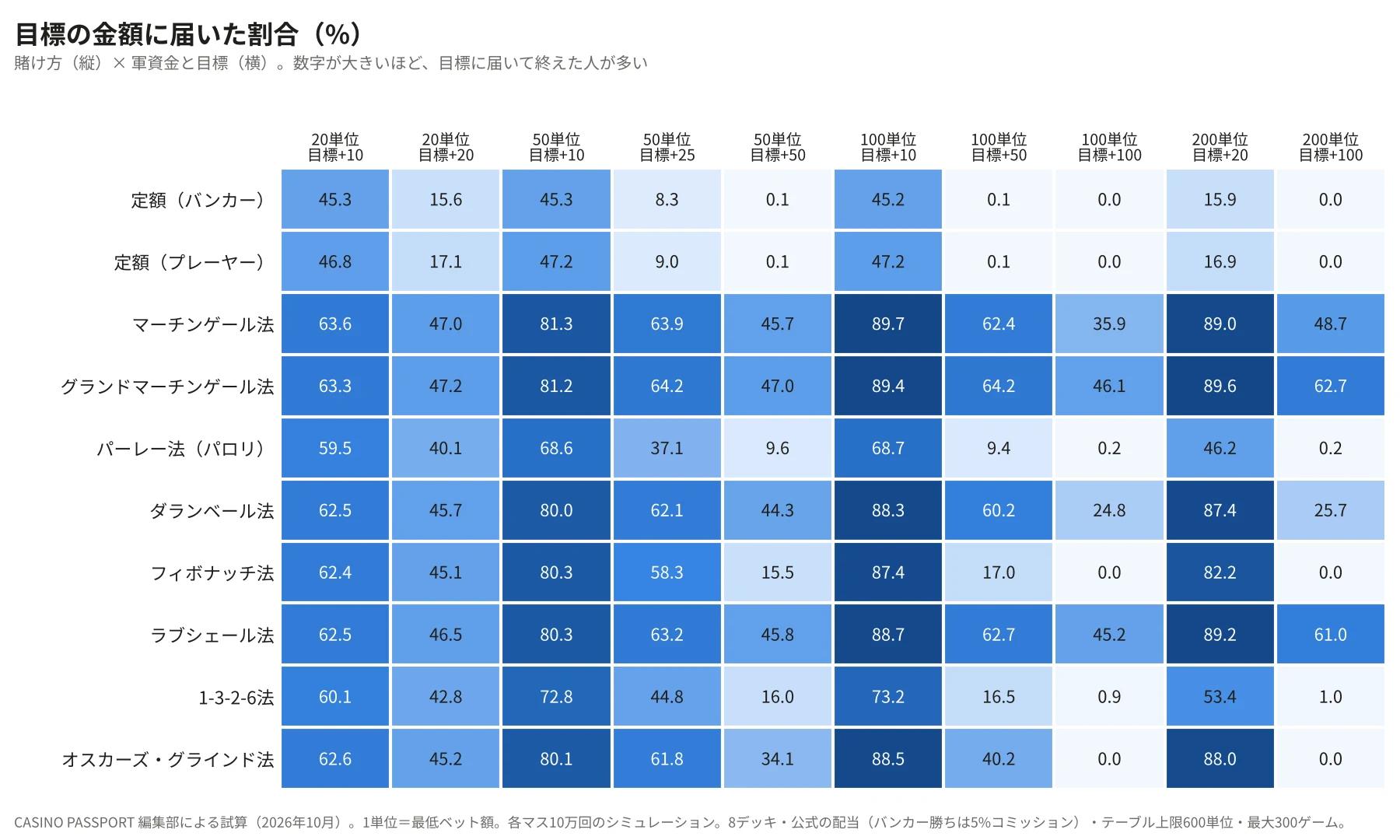
When betting the same amount every time, many sessions ran out of time before reaching the target. Even with a bankroll of 100 units and a target of +10 units, only about 45% reached the target. Under the same conditions, about 89 to 90% of sessions reached the target with the Martingale, Labouchère and Grand Martingale systems.
Result 2: share of sessions that lost the whole bankroll
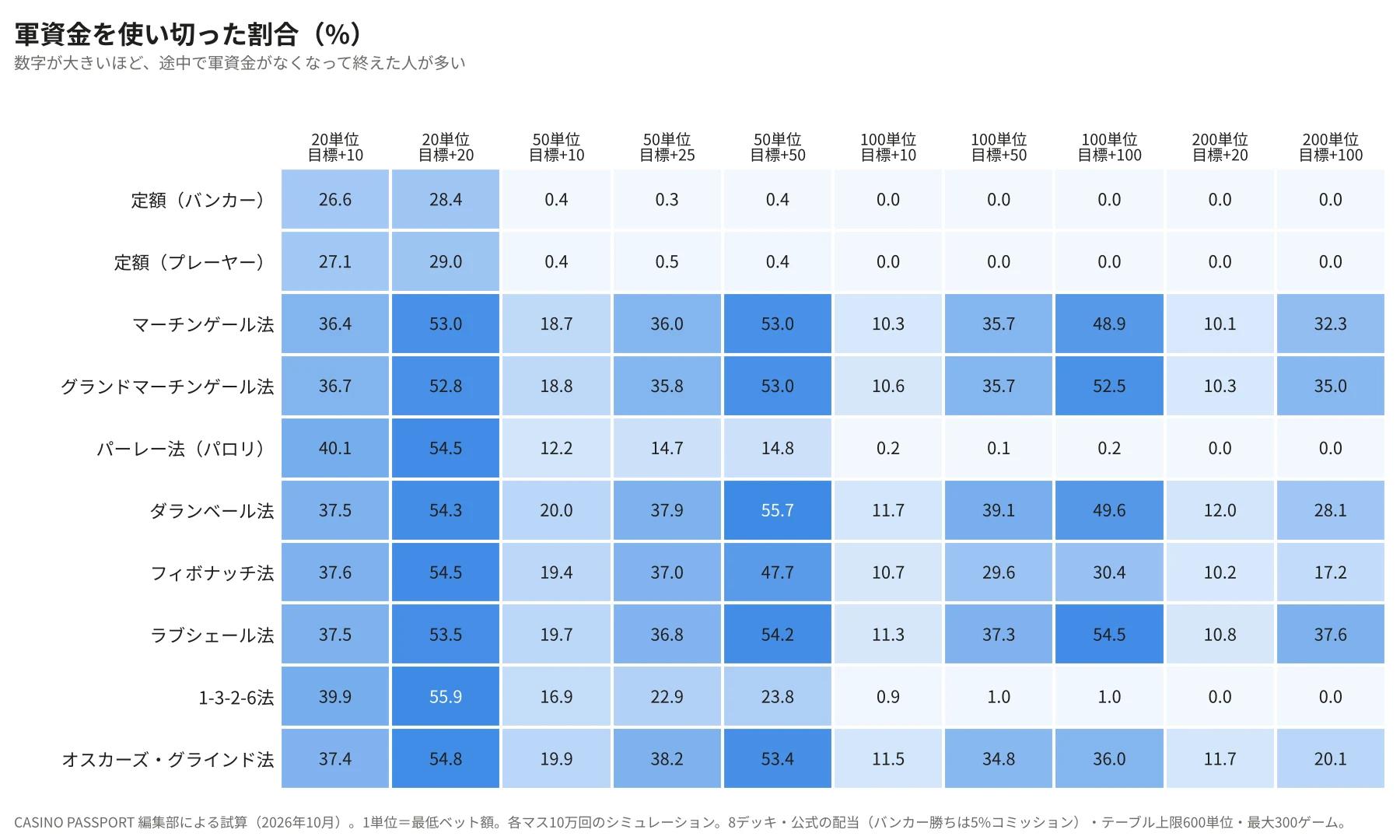
Betting methods with a high share of sessions reaching the target also have a high share of sessions losing the whole bankroll. With the Martingale, a bankroll of 100 units and a target of +10 units, about 90% of sessions ended at +10 units, while about 10% lost almost the entire bankroll (about 100 units). It is a pattern of many small wins and rare big losses, and in total the average is negative. When betting the same amount every time, almost no one lost the whole bankroll under these conditions.
Result 3: how much was lost on average
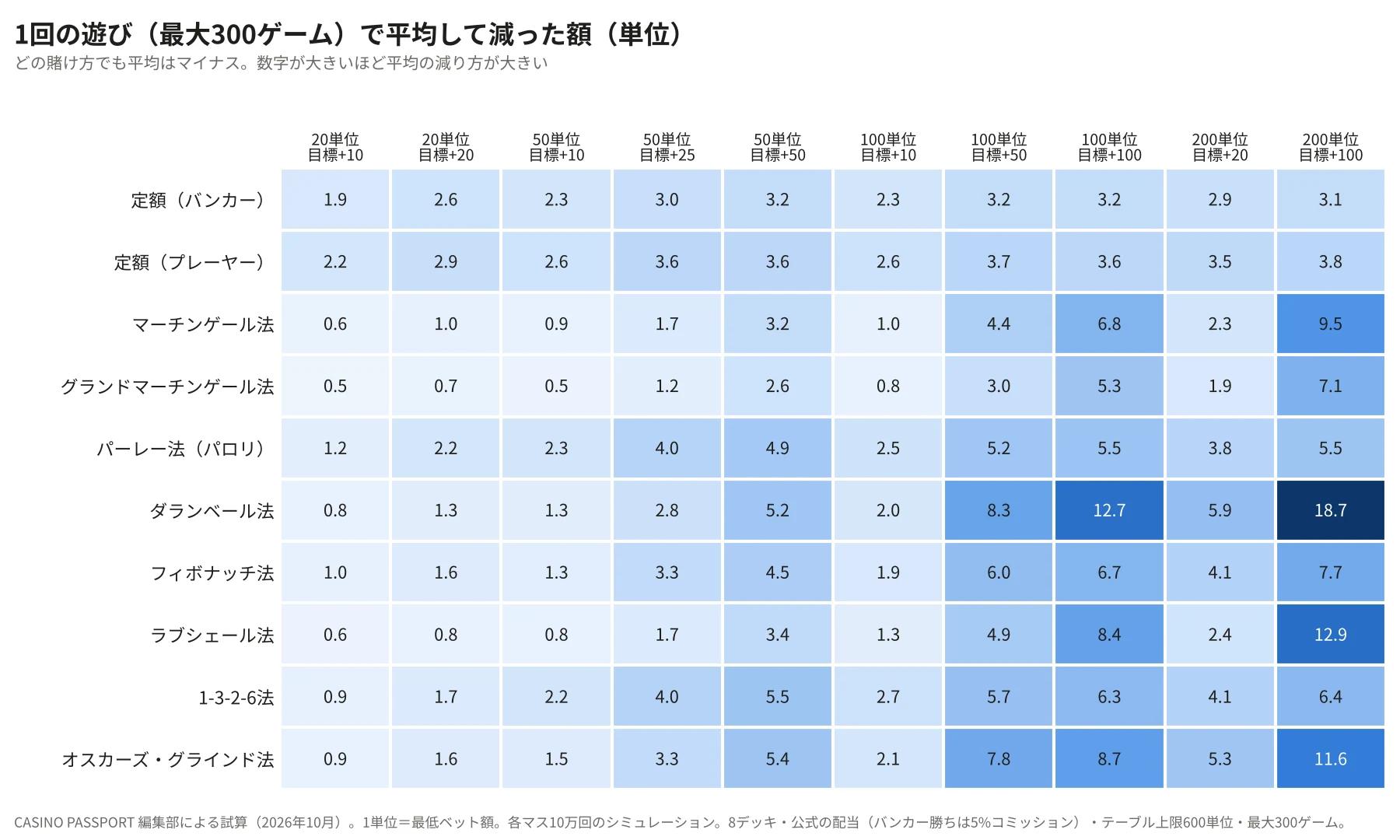
The average result was negative in every combination. Dividing the average loss by "the total amount bet," all 100 combinations fell within about 0.9 to 1.4%, almost the same as the theoretical values (about 1.17% for Banker and about 1.37% for Player, excluding Ties). In other words, changing the betting method does not change the rate of loss, and methods that raise the bet size lose more on average because the total amount bet grows. For example, with a bankroll of 200 units and a target of +100 units, the average was about −18.7 units for D'Alembert and about −3.1 units for Flat bet (Banker).
The Martingale stops at the "table maximum"
The Martingale is the idea of doubling your bet after every loss so that one win recovers your losses. But if you start at 1 unit, after 10 losses in a row the 11th bet would need to be 1,024 units (KRW 51,200,000), which is over the 600-unit maximum (KRW 30,000,000). At that point you can no longer double, and the losses so far cannot be recovered.
The probability of losing 10 times in a row when betting on Banker is about 0.085% (excluding Ties), or about 1 in 1,175. That looks rare, but when we prepared a bankroll of 1,023 units (enough to keep doubling through 10 losses in a row, KRW 51,150,000) and aimed for +100 units, about 10% of 100,000 simulated sessions hit the maximum along the way, and the average result was about −14.9 units.
Number of hands and results: short sessions end ahead more often, but the average always goes down
When betting 1 unit on Banker every time, the share of people who ended up ahead and the average amount lost were as follows (100,000 runs each).
| Hands played | Ended up ahead | Average result |
|---|---|---|
| 30 | approx. 49% | −0.3 units |
| 100 | approx. 45% | −1.0 units |
| 300 | approx. 42% | −3.2 units |
| 1,000 | approx. 36% | −10.4 units |
| 3,000 | approx. 27% | −31.7 units |
| 10,000 | approx. 13% | −105.9 units |
After 300 hands, the middle 90% of people were between −29.9 and +23.4 units. The average is negative at every number of hands.
Over a short time, results swing a lot with luck (variance), and nearly half of people end up ahead. However, the average loss grows in proportion to the number of hands played (about 1.06% per hand), while the size of the swings does not grow as fast. So the more you play, the more the average loss, rather than the swings, decides the result. This is why "people who stop early end up ahead more often." It does not mean that short sessions pay off. Even over a short time, the average is negative.
Can the scoreboard (display of past results) predict the next hand?
Baccarat tables sometimes have a screen showing past wins and losses (the scoreboard, also called "roads"). So we used a computer to deal 200,000 shoes of 8 decks (about 16.28 million games) the same way they are dealt in practice, and counted how past results relate to the next result.
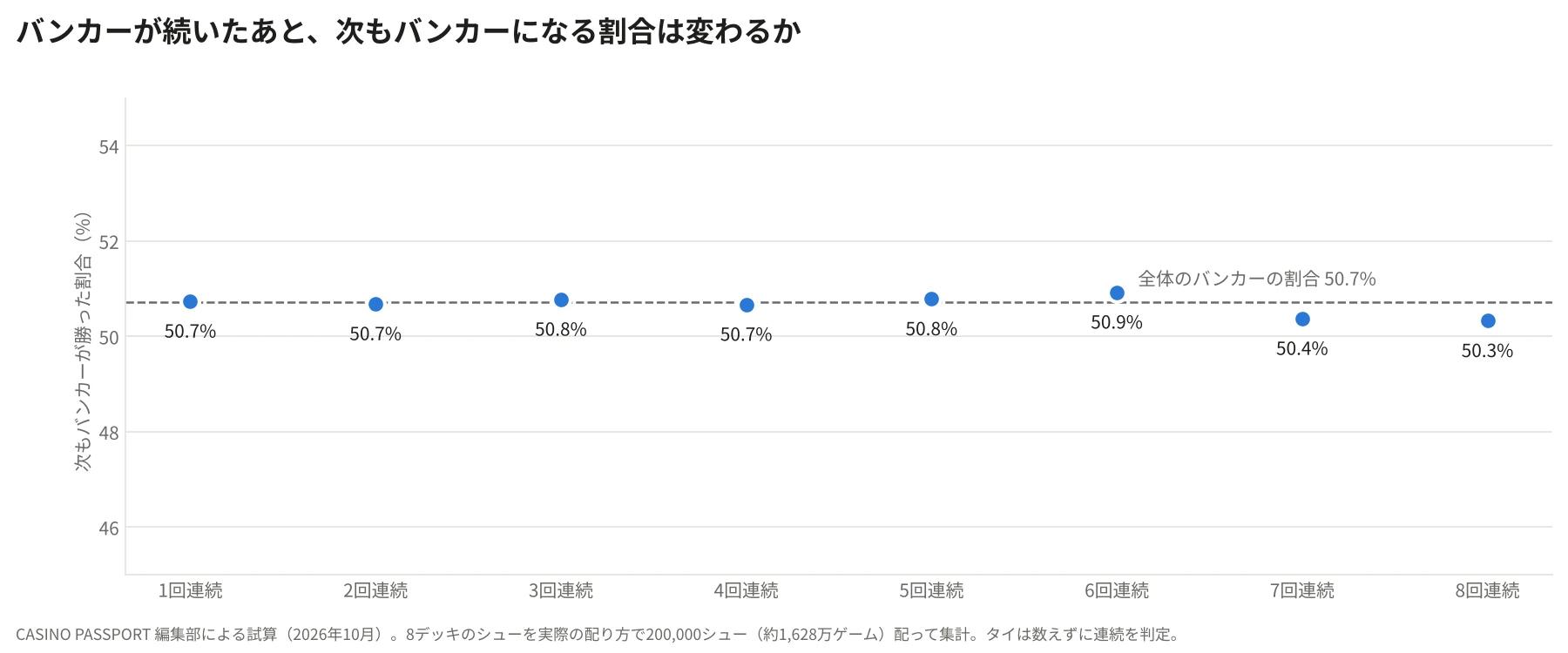
- Excluding Ties, Banker won about 50.7% of hands overall
- After Banker won 1 to 8 times in a row, Banker also won the next hand about 50.3 to 50.9% of the time, almost the same as overall
- After a run of Player wins, and after Banker and Player alternated 4 times, the share of next results was also almost the same as overall
- Within one shoe (about 74 games on average, excluding Ties), a run of 6 or more Banker wins appeared in about 46% of shoes, 8 or more in about 14%, and 10 or more in about 3.6%
Long streaks are not unusual, and a streak does not change the probability of the next hand. In theory, used cards leaving the shoe have some effect, but it is tiny, and the difference was never large enough to predict anything from the display.
What the numbers say to decide before you play
- Decide in advance how much you will spend, separately from your travel budget (see how to plan your budget for a Korean casino)
- No betting method changes the average rate of loss. Methods that raise the bet size occasionally lose big
- The longer you play, the more you lose on average, at the rate of the house edge. Decide in advance when you will stop, too
- The Tie has a house edge of about 14.4%, more than 10 times that of Banker or Player
Entry requirements and what to expect on the day are covered in a guide for first-time visitors to Korean casinos. The 8 casinos covered on this site are for foreign visitors only (Korean nationals are not admitted) and are open to visitors aged 19 and over.
A comparison with other games is in the house edge table, and figures for the Tie and pair bets are in Side bets explained.
Summary
In baccarat, whichever side you bet on and whatever betting method you use, the longer you play, the more you lose on average, at about 1% of the amount you bet. The only thing a betting method changed was the shape of the results: "many small wins and a rare big loss" or "a slow, steady decline." Now that you know the numbers, decide in advance how much money and time you will spend, and enjoy yourself.
How we calculated: the probabilities per game were calculated by counting every combination in 8 decks (also calculated with 6 decks). For the betting methods, we used those probabilities to reproduce 100,000 sessions per combination on a computer. For the scoreboard check, we dealt 8-deck shoes the way they are dealt in practice (ending with 16 cards left) and counted the results (CASINO PASSPORT editorial team, October 2026).
CASINO PASSPORT editorial team
The CASINO PASSPORT editorial team presents travel information that includes legal, real-world casinos abroad, explained clearly for travelers from Japan. We check facility information against official websites, operating companies and public tourism information, and update it with a focus on accuracy and freshness. We do not introduce or recommend online casinos.
Related casinos
Facility images include illustrations and photos provided by the facilities. Credits for provided photos are shown on each facility page.

Related articles
Article images are illustrations, not photos of actual facilities.
Side Bets: Calculating the House Edge of the Tie, Pair Bets and Insurance
We calculated the house edge of side bets from the official payouts and compared them with the main bets: the baccarat Tie, pair bet and no-commission Banker; blackjack insurance, even money and pair bet; and Pair Plus in Three Card Poker.
Blackjack by the Numbers: Strategy Chart, and Hit or Stand on 12 or 13
We calculated the expected value in blackjack and summarized a strategy chart by dealer card (hit, stand, double, split, surrender), the win and loss rates of hitting and standing on tricky totals such as 12 or 13, and the dealer's bust rate.
Casino House Edge Table: Comparing Baccarat, Blackjack, Roulette and Sic Bo
We calculated the house edge (the percentage of your bet you lose on average) for Baccarat, Blackjack, Roulette, Sic Bo and Three Card Poker from the official payouts and put them in one table. We also show how much Sic Bo bets differ, plus some fun probabilities.
Caribbean Stud Poker Rules and How to Play | What to Know Before Your First Game at a Korean Casino
A guide to Caribbean Stud Poker at Korean casinos: how you play five cards against the dealer, hand rankings, the Ante and Double Bet, and payouts by hand, based on the game guide on the official Paradise Casino website.
Three Card Poker Rules and How to Play | What to Know Before Your First Game at a Korean Casino
A guide to Three Card Poker at Korean casinos: how you play three cards against the dealer, hand rankings, Ante and Play bets, and Pair Plus payouts, based on the game guide on the official Paradise Casino website.

How to Play Slot Machines and Electronic Table Games (ETG) | A Korea Casino Guide for Beginners
A beginner's guide to slot machines and electronic table games (ETG) at Korean casinos: machine types, how to play, how tickets (TITO) work, and the number of machines at the 8 main casinos, based on each casino's official website.